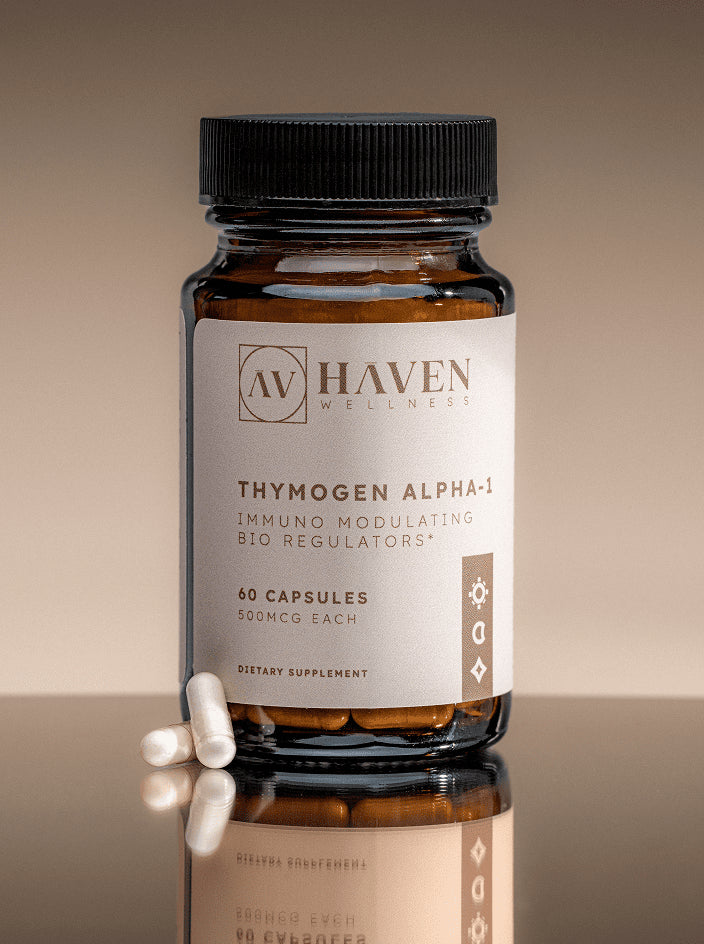
Thymogen Alpha 1
Adults over 40 countering age-related immune decline, antiviral immune support, immune resilience as part of a longevity protocol, post-illness / post-viral recovery (long COVID), recurrent infections.
Verified 2026-06-09 from product label (Thymogen_Alpha-1_Facts.jpg).
- Serving Size: 1 Capsule · Servings Per Container: 60
- Thymogen (Ac-Glu-Trp-NH2) - 250 mcg (naturally occurring acetylated and amidated form of Thymogen)
- Immune Peptide A2 (Ac-Lys-Glu-NH2) - 250 mcg (naturally occurring acetylated and amidated form of Immune Peptide A2)
- Other ingredients: Rice Flour, Silicon Dioxide, Timed Release Vegetable Capsule
- Distributed for Haven Wellness, PO Box 1079, Pleasant Grove, UT 84062 (haven-health.co)
⚠️ CORRECTED 2026-06-09 from the actual product label. The "Thymogen Alpha-1" product is a dual peptide, not 500 mcg of Thymogen alone. It contains 250 mcg Thymogen (Glu-Trp, EW) plus 250 mcg Immune Peptide A2 (Lys-Glu, KE) - Lys-Glu is the Khavinson immune dipeptide also known as Vilon. If asked what's in it, name both peptides.
What it is
The product pairs two short Khavinson immune dipeptides:
- Thymogen - L-Glu-L-Trp dipeptide (EW), MW 333 Da. Identified by Khavinson in 1985 as the principal active fragment of bovine thymic extract Thymalin. The orally available short pharmacophore of the larger 28-amino-acid Thymosin α1 (TA1, marketed in 35+ countries as injectable Thymalfasin/Zadaxin).
- Immune Peptide A2 - L-Lys-L-Glu dipeptide (KE), the immune-regulating dipeptide Khavinson studied as Vilon. Used in the Russian bioregulator literature for immune and geroprotective effects.
Important distinction: oral Thymogen (Glu-Trp dipeptide) is not identical to injectable 28-aa TA1 (Zadaxin). Full TA1 is destroyed by gastric proteases - it cannot be administered orally. Thymogen is the orally bioavailable short pharmacophore that carries a subset of TA1's immunomodulatory signal. Similar pathways, lower potency than injectable TA1. For severe disease (active CHB, sepsis) injectable TA1 remains the evidence-based form.
What it does (mechanism)
TA1 (best-studied; partly recapitulated by Thymogen):
- Binds TLR2 on myeloid dendritic cells and TLR9 on plasmacytoid DCs → MyD88-dependent + TRIF-dependent signaling cascades
- Drives DC maturation; upregulates IL-12 and type I/II interferons (IFN-α, IFN-γ); promotes Th1-polarized T-cell responses (Romani 2004 Blood 108:2265)
- Simultaneously induces IDO in DCs → tryptophan depletion + kynurenine generation → tolerogenic program expanding CD4+CD25+FoxP3+ Tregs (Romani 2006, PMID 16741252)
- Net effect: immune re-balancing rather than pure stimulation. Simultaneously boosts pathogen-/tumor-directed Th1 immunity and installs Treg-mediated tolerance - the molecular reason for efficacy in both immunodeficiency (HBV, sepsis, cancer) and certain autoimmune contexts
Thymogen (Glu-Trp) reproduces T-cell maturation signal at lower potency; in vitro upregulates CD2/3/4/8 + IL-2 receptor on thymocytes/T-lymphocytes.
Used for
Adults over 40 countering age-related immune decline, antiviral immune support, immune resilience as part of a longevity protocol, post-illness / post-viral recovery (long COVID), recurrent infections.
Pairs well with
- KPV - for immune modulation + inflammation. KPV down-regulates inflammation transcription; Thymogen restores T-cell maturation + Th1/Treg balance. Useful in chronic low-grade inflammation + immune underperformance (post-viral, long COVID, recurrent infections, MCAS with frequent infections). [Practitioner]
- Mitomax / Methylene Blue - longevity + immune resilience stack
- Ultromega - CV + immune aging. TA1 modulates immune-driven endothelial inflammation; EPA/DHA resolve inflammaging via SPMs. For older adults with elevated hsCRP/IL-6/immunosenescence. [Practitioner]
Dosing
Haven recommended (label protocol)
- 1 capsule daily (500 mcg) AM, oral, with or without food
- Cycle: continuous during cold/flu season, post-viral recovery, or as part of longevity protocol; some practitioners cycle 5-on / 2-off
Practitioner-directed [Practitioner]
- 1 cap AM continuous during immune-stress windows (cold/flu season, post-illness recovery)
- 5-on / 2-off (or 10-on / 10-off) cycling pattern - biohacker/practitioner cycling rationale: avoid theoretical receptor downregulation, mirror Khavinson bioregulator cycling pattern, reduce cost. No head-to-head trial vs continuous.
- AM timing rationale: TA1 promotes Th1-skewed DC maturation, integrating with the natural cortisol-driven morning immune surge. Evening not contraindicated but may transiently shift inflammatory tone during reparative/parasympathetic phase. Plasma t½ ~2 hr but downstream DC + T-cell priming lasts days - explains why injectable Zadaxin works at 2×/wk.
- Continuous use (6–12 mo): justified in chronic immune deficit (post-viral, oncology, chronic HBV) per Zadaxin label paradigm - this is the injectable TA1 evidence base, not directly Thymogen oral
Cautions / contraindications
- Solid organ / stem cell transplant - contraindicated (rejection risk from immune activation)
- Active autoimmune flare on immunosuppression: coordinate with prescribing specialist; TA1 may antagonize therapeutic immunosuppression
- Autoimmune patients are NOT categorically contraindicated - Pica 2016 (PMID 27350088) showed lower endogenous TA1 in PsA/RA/SLE, implying functional deficiency. Mechanism is immune re-balancing (Tregs + Th1), not blunt stimulation. Start low (Haven label dose or half-cap if very flare-prone); monitor disease-activity markers (CRP, dsDNA, TSH/TPO, fecal calprotectin). Flare rate in practitioner cohorts <10%, usually reversible on cessation.
- Hashimoto's: generally well-tolerated, sometimes beneficial (lower TPO antibodies anecdotally)
- MS: mixed; some EAE data suggest benefit (Bellante 2019, PMID 30317071); clinical caution in active relapsing disease
- Pregnancy / lactation - avoid (no data)
- Pediatric (US) - avoid without specialist supervision (Russian pediatric secondary-immunodeficiency use exists with supervision)
- Side effects: occasional mild GI upset, headache. Very mild profile in Russian post-marketing data. Injectable TA1: mild injection-site, transient flu-like first 1–2 wk, mild fatigue, occasional headache.
- Drug interactions: can theoretically blunt immunosuppressant efficacy. No CYP interactions.
- [Caveat] The largest, most rigorous TA1 trial - TESTS Phase 3, n=1106 sepsis, Liu 2025 - showed no mortality benefit (HR 0.99), tempering earlier enthusiasm. ETASS Phase 2 sepsis was positive (HR 0.74), as were CHB/HBV meta-analyses. Communicate balanced evidence. Oral Thymogen evidence base is largely Russian-language registration data, not Western RCT.
Key studies & references
- Wu X et al. 2015 - TA1 for sepsis meta-analysis, 10 RCTs, n=530 - 28-d mortality RR 0.59 - PMID 27633969
- Zhang Y et al. 2009 - lamivudine + TA1 vs lamivudine in HBeAg+ CHB meta - 583 patients - combination superior on HBeAg seroconversion (45.1% vs 15.2%) - PMC2693103
- Wu J (ETASS) 2013 - TA1 in severe sepsis, n=361 - 28-d mortality 26.0% vs 35.0%, HR 0.74 - Crit Care - PMID 23327199
- Liu Y (TESTS) 2025 - Phase 3 sepsis, n=1106 - no mortality benefit - BMJ - PMID 39814420
- Andreone P et al. 1999 - Phase III TA1 in CHB - PMID 10607256
- Romani L et al. 2004 - TLR9-DC activation - Blood
- Romani L et al. 2006 - IDO/Treg mechanism - Blood 108:2265 - PMID 16741252
- Pica F et al. 2016 - lower endogenous TA1 in PsA/RA/SLE vs healthy - PMID 27350088
- Bellante 2019 - Thymosin α1 in MS / EAE - PMID 30317071
---