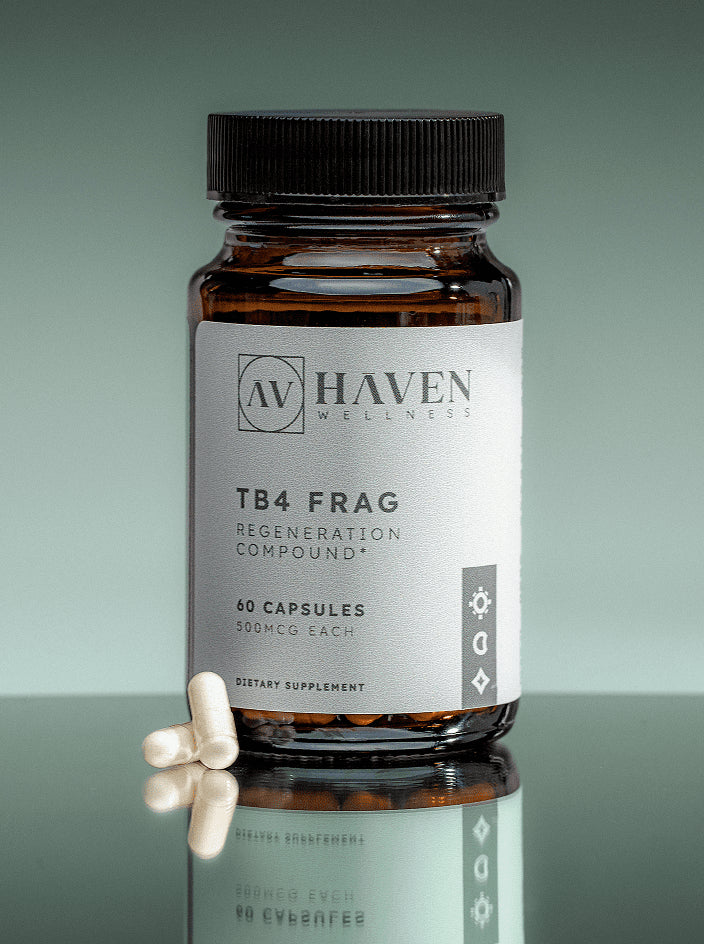
TB4 Frag
Neurological health, cognitive resilience, comprehensive athletic recovery, post-surgical recovery, cardiovascular and anti-fibrotic support during aging.
Verified 2026-06-09 from product label (TB4-Frag_Facts.jpg).
- Serving Size: 1 Capsule · Servings Per Container: 60
- TB4-Frag - 500 mcg (naturally occurring acetylated and amidated form of TB4-Frag)
- Other ingredients: Rice Flour, Silicon Dioxide, Timed Release Vegetable Capsule
- Distributed for Haven Wellness, PO Box 1079, Pleasant Grove, UT 84062 (haven-health.co)
What it is
An oral formulation of Ac-SDKP (N-acetyl-Ser-Asp-Lys-Pro), the N-terminal tetrapeptide fragment of Thymosin β4 (Tβ4). MW 487 Da. Endogenous - released in vivo from Tβ4 by sequential cleavage: meprin-α (kidney brush border) → prolyl oligopeptidase (POP). Circulates at ~3 nM plasma. Degraded almost exclusively by the N-terminal active site of ACE - this is why ACE inhibitors (captopril, lisinopril, enalapril) raise plasma Ac-SDKP ~5-fold, and part of the long-term anti-fibrotic benefit of ACEi therapy may operate through this mechanism.
Why the fragment, not full Tβ4: full-length Tβ4 is ~1% orally bioavailable (too big, protease-sensitive). Ac-SDKP at 4 residues + N-acetylated (which blocks aminopeptidases) achieves ~30% oral bioavailability in rodents and is ~10× more potent than Tβ4 by weight for fibrosis endpoints. The rare oral peptide whose smaller fragment is both more bioavailable and more potent than its parent.
What it does (mechanism)
Distinct from full-length Tβ4 (which sequesters G-actin for cell migration). Ac-SDKP operates via:
- TGF-β / Smad pathway inhibition - blocks TGF-β1-induced Smad2 phosphorylation, suppresses fibroblast → myofibroblast transition and downstream collagen I/III synthesis (Kanasaki 2014; Pokharel et al.). The dominant anti-fibrotic mechanism.
- Anti-inflammatory / macrophage modulation - suppresses macrophage infiltration and NF-κB; polarizes macrophages toward reparative M2
- Pro-angiogenic signaling - increases endothelial proliferation/migration; raises capillary density in post-infarct + ischemic tissue (Wang et al.)
Recent work shows Ac-SDKP inhibits ER stress-induced collagen production in cardiac fibroblasts via suppression of CHOP/NF-κB axis (Frontiers in Pharmacology 2024). It also inhibits hematopoietic stem cell proliferation - physiological role but warrants caution in pancytopenia / chemotherapy contexts.
Used for
Neurological health, cognitive resilience, comprehensive athletic recovery, post-surgical recovery, cardiovascular and anti-fibrotic support during aging.
Pairs well with
- BPC-157 - the Wolverine repair stack. BPC drives angiogenesis + GH-receptor signal; TB4 Frag drives anti-fibrotic + anti-scarring. Different repair phases. [Practitioner]
- Epitalon - full Muscle Growth & Recovery Stack (sleep-phase repair)
- KPV - when injury also has inflammation component
- Methylene Blue - neural/cognitive repair. Ac-SDKP handles cellular/inflammatory; MB handles bioenergetic/mitochondrial. CRITICAL: MB is a potent MAO-A inhibitor - do NOT combine with SSRIs/SNRIs/MAOIs/triptans (serotonin syndrome risk). [Practitioner]
- Mitomax - mitochondrial repair. Ac-SDKP prevents fibrotic remodeling of mitochondrial-rich tissue (heart, brain, muscle); Mitomax supplies cofactors + antioxidants (NAC, ALCAR, R-ALA, B-complex).
Dosing
Haven recommended (label protocol)
- 1 capsule daily (500 mcg), oral, on an empty stomach
- AM (single daily dose) preferred - see timing rationale
- Continuous use; courses of 8–12 weeks with optional 2–4 week breaks
Practitioner-directed [Practitioner]
- 1 cap BID (1 mg/day) split AM + PM, empty stomach, 3–4 hr apart
- Aggressive (post-surgical, post-MI rehabilitation context): 1 cap TID
- Cycle: 8–12 weeks on, 2–4 off. Some practitioners run continuously for fibrotic indications since Ac-SDKP is endogenous.
- Empty-stomach rationale: polar hydrophilic tetrapeptide; rapid gastric emptying without competing protein bolus improves absorption
- AM rationale: circadian peak of ACE (degrading enzyme) activity; front-loads ahead of degradation
- PM rationale: repair processes peak overnight
- 3–4 hr spacing: plasma t½ short (≤1 hr without ACEi); spacing maintains exposure
- ACE inhibitor users: will have endogenously elevated Ac-SDKP - not a contraindication, but consider starting at the lower Haven label dose; the additive effect is likely the most physiologically potent combination for CV/renal anti-fibrotic outcomes (no formal clinical trial)
Cautions / contraindications
- Active malignancy / cancer history - pro-angiogenic profile (same theoretical tumor-progression concern as BPC); hematopoietic-suppressive (S-phase inhibition) is more concerning in hematologic malignancies
- Pregnancy / lactation / pediatric - no data, avoid
- Active hemorrhage - hold
- Bone marrow suppression / cytopenias / active chemotherapy - relative contraindication via S-phase inhibition (paradoxically also studied as a protector of stem cells from cytotoxics, but this is investigational)
- ACE inhibitor users - start at Haven label dose; expect higher-than-average response
- Hypotension - mild vasodilatory effect via NO/bradykinin; theoretical additive with antihypertensives
- Not FDA-approved - sold via compounding pathways
- Long-term human safety data essentially absent at supraphysiologic doses
Key studies & references
- Peng H, Carretero OA et al. 2003 - Ac-SDKP Reverses Cardiac Fibrosis in Renovascular Hypertension - Hypertension 42:1164 - DOI 10.1161/01.HYP.0000100423.24330.96
- Peng H et al. 2001 - antifibrotic in aldosterone-salt rats - PMID 11230375
- Yang F et al. 2004 - reverses inflammation/fibrosis post-MI - Hypertension - PMID 14691195
- Sharma U et al. 2018 - decreased mortality and cardiac rupture after AMI in mice - PMC5783348
- Nitta K et al. 2016 - oral Ac-SDKP ameliorates diabetic kidney disease in T1D + T2D mice - PMC4818806 (the strongest published rationale for the oral capsule format)
- Conte E et al. 2016 - Ac-SDKP in bleomycin pulmonary fibrosis (preventive + therapeutic) - PMC5085123
- Kanasaki K 2014 - comprehensive review, Ac-SDKP in diabetic kidney fibrosis - Front Pharmacol 5:70
- Zuo Y et al. 2022 - Tβ4-POP-Ac-SDKP axis in organ fibrosis review - PMC9655242 (best single review)
- Kumar N et al. 2016 - meprin-α + POP release pathway - PMID 26962108
- Cavasin MA et al. 2007 - decreased endogenous Ac-SDKP correlates with fibrosis - DOI 10.1161/HYPERTENSIONAHA.106.084103
---