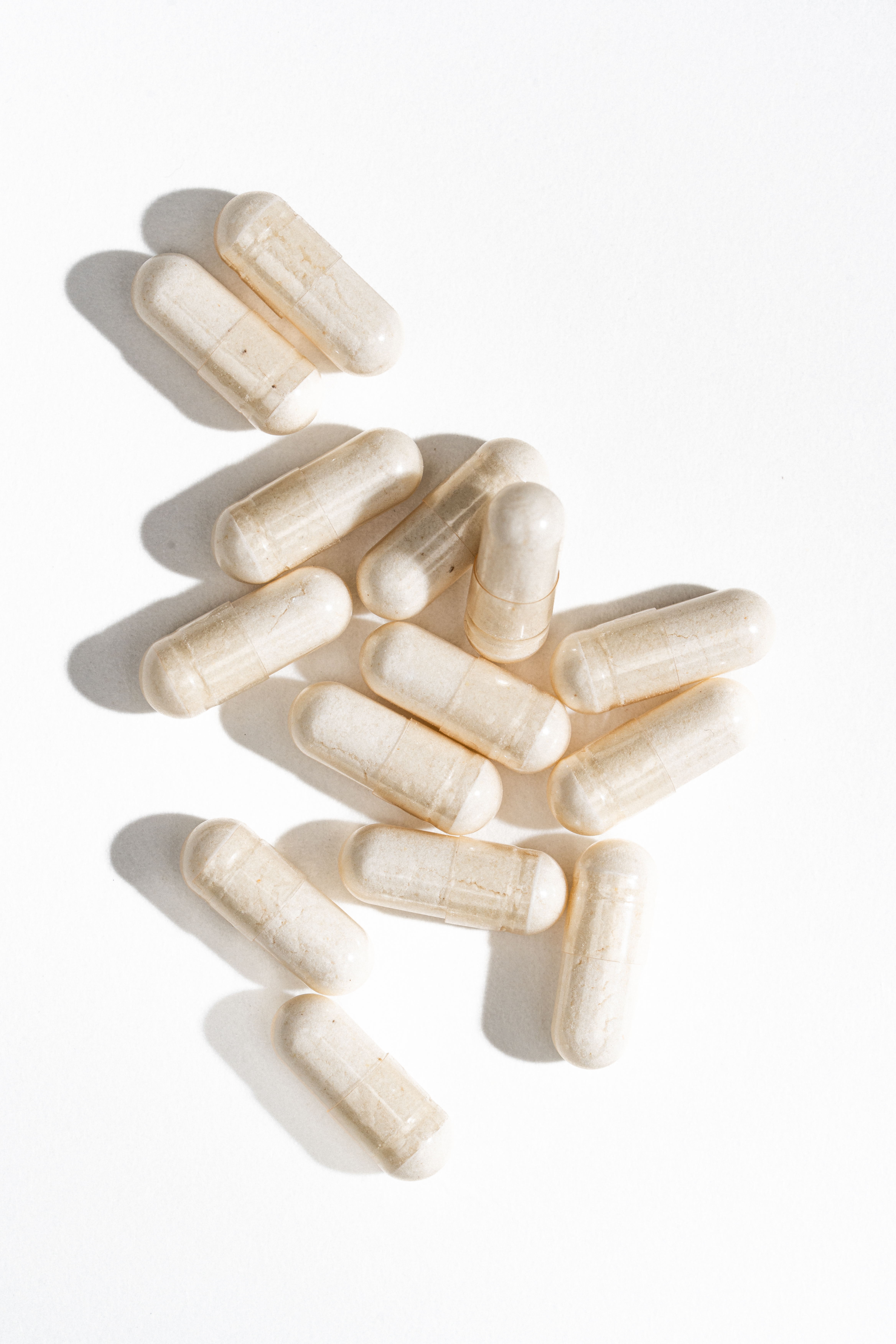
Methylene Blue
Adults seeking mitochondrial energy, cognitive performance, antioxidant support; longevity protocols.
Verified 2026-06-09 from product label photo (Karen / Blue Mountain email thread "Re: Haven products Methylene blue capsules", image IMG_6706.jpg).
- Serving Size: 2 Capsules · Servings Per Container: 30 (60 capsules)
- Vitamin C (as Ascorbyl Palmitate): 38 mg (42% DV)
- Methylene Blue (Methylthioninium Chloride): 12 mg
- Cacao Powder: 240 mg
- Other ingredients: Rice Flour, Vegetable Capsule
- Distributed for Haven Wellness, PO Box 1079, Pleasant Grove, UT 84062 (haven-health.co)
- Dosing note: 12 mg MB per serving is a conservative microdose - at or below the low end of the ~15–80 mg cognitive range, well clear of the high-dose pro-oxidant zone.
What it is
USP pharmaceutical-grade methylene blue (MB; methylthioninium chloride). Third-party tested for heavy metals - not industrial or dye-grade. Phenothiazine dye, first synthesized by Heinrich Caro at BASF 1876; Paul Ehrlich treated malaria with it in 1891 (arguably the world's first fully synthetic pharmaceutical); structural parent of phenothiazine antipsychotics. Current FDA-approved indications limited to acquired methemoglobinemia (1–2 mg/kg IV), ifosfamide encephalopathy, vasoplegic syndrome, surgical mapping. All cognitive/mitochondrial/anti-aging/neurodegenerative applications are off-label.
Haven's product is a low-dose oral capsule (12 mg MB per 2-capsule serving), paired with Vitamin C and cacao powder. The Vitamin C (ascorbyl palmitate) is mechanistically relevant - ascorbate keeps MB in its reduced leucomethylene-blue form, the configuration that supports the electron-cycling described below; cacao powder serves as a flavanol-containing carrier/taste-and-stain mask.
What it does (mechanism)
Electron cycling. MB is a redox-cycling molecule with reduction potential ~+11 mV that sits between NADH/NAD+ and cytochrome c in the ETC. At low concentrations it accepts electrons from NADH (and complex I when partially inhibited) and donates them downstream to cytochrome c - effectively bypassing complexes I–III. This increases complex IV (cytochrome c oxidase) activity, raises oxygen consumption, increases ATP output, and - counterintuitively - reduces superoxide leak because electrons aren't stalling at I/III. Crosses BBB readily; accumulates in mitochondria (cationic, lipophilic). At low doses also reversibly inhibits MAO-A - clinically critical (see Cautions).
The U-shaped (hormetic) dose-response curve is the single most important pharmacological fact:
- Low dose (~0.5–1 mg/kg or ~15–80 mg human) = pro-mitochondrial, net antioxidant, cognitively enhancing
- High dose (>7 mg/kg) = pro-oxidant, can inhibit respiration, methemoglobinemia in G6PD-deficient, fatal serotonin syndrome when combined with serotonergic drugs
More is decisively not better.
Used for
Adults seeking mitochondrial energy, cognitive performance, antioxidant support; longevity protocols.
Pairs well with
- Mitomax - mitochondrial stack: MB cycles electrons in the ETC while Mitomax supplies cofactors + antioxidants (NAC, ALCAR, R-ALA, B-complex). [Practitioner]
- Epitalon - longevity stack: mitochondrial axis (MB) + nuclear/telomere axis (Epitalon). Non-overlapping mechanisms.
- TB4 Frag - when cognitive + neural support is the goal. CRITICAL: serotonin syndrome warning still applies.
- Red / near-infrared light (photobiomodulation) - both increase cytochrome c oxidase activity. MB absorbs at ~660 nm (red-light wavelength). Anecdotal additive cognitive effect with MB 30–60 min before red light. Caveat: photoactivation also generates singlet oxygen - keep MB low if pairing with intense PBM. [Community]
Dosing
Haven recommended (label protocol)
- Take per Haven label - pharmaceutical-grade USP dosing in the cognitive/mitochondrial range (low-dose, well under the methemoglobinemia threshold)
- Morning, with or without food
- Counsel patients to expect blue-green urine (universal). Possible blue tinge to stool/sweat. Pharmaceutical troches/capsules avoid the tongue/teeth staining of liquid forms.
Practitioner-directed [Practitioner]
- Off-label clinical practitioner range: ~0.5–1 mg/kg = 10–50 mg PO once daily AM. Some titrate up to ~2 mg/kg (often capped 80–100 mg) - upper end of the safety U.
- Titration: start at the lowest dose, observe 1–2 weeks, titrate up. Lower bound is plenty for most patients.
- AM rationale: mildly stimulating (mitochondrial activation + transient MAO-A inhibition raises catecholamines); evening disrupts sleep in many users.
- With caffeine: anecdotal synergy - caffeine raises cAMP/adenosine antagonism while MB raises ETC throughput. No human trial directly tests combination.
- Empty stomach vs food: oral bioavailability ~70%, not strongly food-dependent. Slight reduction in nausea with food.
CRITICAL — Serotonin syndrome
ABSOLUTE CONTRAINDICATION with any serotonergic agent:
SSRIs (fluoxetine, sertraline, citalopram, escitalopram, paroxetine) · SNRIs (venlafaxine, duloxetine, desvenlafaxine) · TCAs · MAOIs · triptans · tramadol · meperidine · dextromethorphan · St John's wort · 5-HTP · tryptophan · MDMA
MB is a potent reversible MAO-A inhibitor; combination has caused fatal serotonin syndrome, particularly IV but the mechanism applies orally too. Do not start MB without full medication reconciliation. Patients on SSRI must wash out 5 half-lives (for fluoxetine, ~5 weeks) before MB. This warning belongs on Haven's intake form, not just the product reference.
Cautions / contraindications
- Serotonin syndrome with serotonergic drugs - ABSOLUTE CONTRAINDICATION (above)
- G6PD deficiency - MB can cause hemolytic anemia + paradoxical methemoglobinemia. Screen patients with relevant ancestry (Mediterranean, African, Southeast Asian) before dosing.
- Pregnancy - Category X for intra-amniotic (fetal jejunal atresia, hemolysis); oral not established - avoid
- Lactation - avoid
- Renal impairment - renally cleared; reduce or avoid in severe CKD
- CYP1A2 substrate; theoretical interactions with bupropion (lowers seizure threshold)
- Source quality non-negotiable - industrial/aquarium-grade MB contains heavy metals (Pb, As, Hg). USP pharmaceutical grade with COA only.
- High-dose methemoglobinemia - paradoxically caused by the drug used to treat it above ~7 mg/kg
- [Caveat] The TauRx LMTM Phase 3 program in Alzheimer's failed primary endpoint in both pivotal trials (Gauthier 2016, Wilcock 2018). The "MB cures Alzheimer's" claim circulating in biohacker spaces is overstated.
Key studies & references
- Rojas JC, Bruchey AK, Gonzalez-Lima F 2012 - comprehensive mechanism review - Prog Neurobiol - PMID 22789712 (cite this prominently)
- Rodriguez P, Zhou W et al. 2016 - multimodal fMRI in n=26 healthy adults, ~7% memory retrieval improvement at 280 mg single dose - Radiology - PMID 27310302
- Telch MJ et al. 2014 - 260 mg post-exposure enhanced fear extinction in claustrophobia - Am J Psychiatry - PMID 25104048
- Riha PD et al. 2005 - rat inverted-U curve, peak ~1–4 mg/kg - PMID 16029873
- Atamna H et al. 2008 - MB delays cellular senescence - FASEB J - PMID 17993577
- Ramsay RR, Dunford C, Gillman PK 2007 - MB MAO-A inhibition + serotonin toxicity - Br J Pharmacol - PMID 17721552
- Gillman PK 2011 - CNS toxicity involving MB - PMID 20142303
- US FDA Drug Safety Communication 2011 - warning against IV MB with serotonergic psychiatric drugs
- Gauthier S et al. 2016 - TauRx LMTM Phase 3 in AD, failed primary endpoint - Lancet - PMID 27863809
---