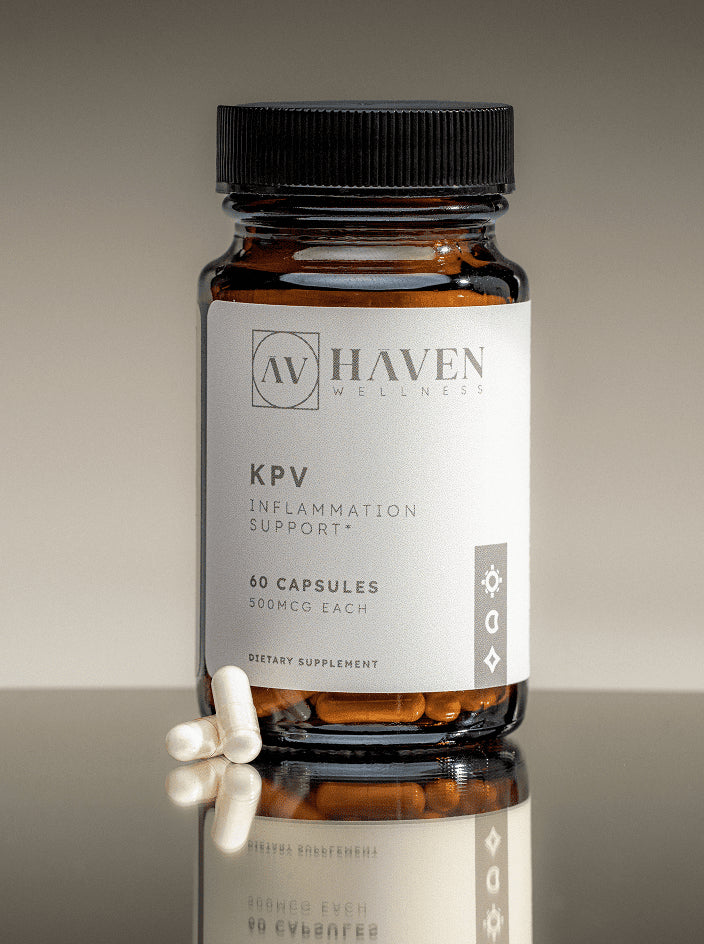
KPV
Chronic digestive inflammation, IBD/Crohn's/colitis markers, leaky gut, gut-skin-immune axis issues, inflammatory skin conditions, histamine-driven problems, immune modulation.
Verified 2026-06-09 from product label (KPV_Facts.jpg).
- Serving Size: 1 Capsule · Servings Per Container: 60
- KPV - 500 mcg (naturally occurring acetylated and amidated form of KPV)
- Other ingredients: Rice Flour, Silicon Dioxide, Timed Release Vegetable Capsule
- Distributed for Haven Wellness, PO Box 1079, Pleasant Grove, UT 84062 (haven-health.co)
What it is
A tripeptide (Lys-Pro-Val) derived from the C-terminal of alpha-MSH (residues 11–13), formulated for oral delivery. Stripping the N-terminal portion of α-MSH removes melanocortin receptor binding (no pigmentation, no MC4R appetite effects) while concentrating anti-inflammatory function. The smallest known α-MSH-derived peptide with full anti-inflammatory function.
What it does (mechanism)
Primary action: intracellular blockade of NF-κB nuclear translocation.
- Enters cell via PepT1 / SLC15A1 (proton-coupled di/tripeptide transporter)
- Competes with NF-κB p65 (RelA) for importin-α3 binding (armadillo repeats 7-8)
- p65 stuck in cytoplasm → transcription of TNF-α, IL-1β, IL-6, IL-8, COX-2, iNOS sharply downregulated
Also suppresses MAPK (p38, JNK); inhibits NLRP3 inflammasome; stabilizes IκBα; shifts macrophages M1→M2. Largely MC-receptor-independent (Kannengiesser 2008) - anti-inflammatory effect persists in MC1R-null cells.
Why oral works: short tripeptide + proline imino-acid resists brush-border peptidases. Actively transported via **PepT1, which is upregulated in inflamed intestinal mucosa in IBD** - KPV literally concentrates in the tissue that needs it most (Dalmasso/Merlin 2007/2008, PMID 18061177).
Used for
Chronic digestive inflammation, IBD/Crohn's/colitis markers, leaky gut, gut-skin-immune axis issues, inflammatory skin conditions, histamine-driven problems, immune modulation.
Pairs well with
- BPC-157 - gut healing stack (BPC for tissue repair, KPV for inflammation). Most-prescribed integrative protocol for IBS/IBD/leaky gut/post-antibiotic dysbiosis. [Practitioner]
- Prebio Plus + Prospore - full gut-rebuild protocol. Sequence: reduce inflammation first (KPV ± BPC for 1–2 weeks) → layer prebiotic substrates → add spore-based probiotics. Throwing spores into hyperinflamed gut can transiently worsen symptoms. [Practitioner]
- Ultromega - anti-inflammatory dual-pathway: KPV blocks NF-κB transcription (acute suppression); EPA/DHA-derived SPMs (resolvins, protectins, maresins) drive active resolution. Complementary, not redundant. [Clinical mechanism]
- Thymogen Alpha 1 - immune modulation + inflammation. For chronic low-grade inflammation + immune underperformance (post-viral, long COVID, recurrent infections, MCAS with frequent infections). [Practitioner]
Dosing
Haven recommended (label protocol)
- 1 capsule daily (500 mcg), oral, on an empty stomach (15–30 min pre-meal)
- 4–8 weeks per course, then re-evaluate
Practitioner-directed [Practitioner]
- 1 cap BID (1 mg/day) for active GI / dermatology / systemic inflammation, empty stomach AM + 30 min pre-dinner
- Higher-end GI/autoimmune: 2–4 caps/day total (1–2 mg/day) split BID
- Empty-stomach rationale: KPV is absorbed via PepT1, which is competitively occupied by dietary di/tripeptides from a meal. Same logic as valacyclovir / cefadroxil (also PepT1 substrates).
- Plasma t½ 1–2 hr → BID maintains continuous mucosal exposure
- Cycle: 4–8 weeks on, 2–4 off
- MCAS / histamine patients: start at ½ cap (≈250 mcg) and titrate over 2 weeks - see Cautions
Cautions / contraindications
- Headache in <5% during first week, self-resolving (likely transient cytokine shift / Herxheimer-like)
- MCAS / histamine intolerance: α-MSH is a known mast-cell stabilizer; most MCAS patients report KPV is helpful. A ~5–10% subset reports first-week flushing/itching/worsening. Start at ½ cap/day in MCAS and titrate over 2 weeks.
- Pregnancy / lactation / pediatric - no data, avoid
- Active malignancy - no mechanistic concern (anti-inflammatory, not mitogenic), but no human safety data - defer to oncology
- Vitiligo / pigmentation: safe (no MC1R binding)
- Drug interactions: theoretical - PepT1 is also the absorption route for cefadroxil, valacyclovir, enalapril. Space dosing by 1–2 hours.
- [Caveat] No published human RCT for oral KPV alone in IBD or skin disease. Evidence is mechanistic + animal models + practitioner case series. Merlin group nanoparticle work is at investigational stages.
Key studies & references
- Dalmasso G et al. 2008 - PepT1-mediated tripeptide KPV uptake reduces intestinal inflammation - Gastroenterology 134:166 - PMID 18061177
- Kannengiesser K et al. 2008 - KPV in DSS + CD45RBhi T-cell transfer colitis - Inflamm Bowel Dis 14:324
- Bettenworth D et al. 2011 - oral KPV in DSS + TNBS colitis; PepT1-KO confirms PepT1 mechanism
- Xiao B et al. 2017 - orally targeted KPV via HA-functionalized nanoparticles, alleviates UC - Mol Ther 25:1628 - PMID 28143741
- Haycock JW et al. 2001 - KPV ameliorates LPS NF-κB translocation in alveolar epithelium - J Biol Chem - PMID 11256945
- Brzoska T, Luger TA et al. 2008 - α-MSH peptides as new class of anti-inflammatory drugs - PMC2095288
- Cutuli M et al. 2000 - direct antimicrobial activity against Candida albicans + S. aureus - J Leukoc Biol 67:233
---