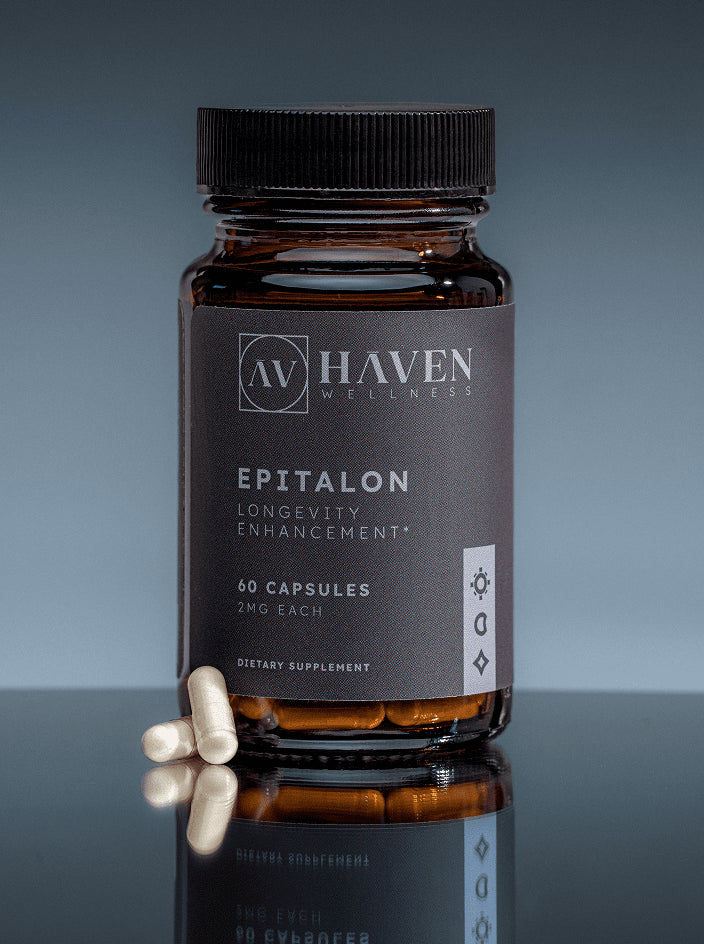
Epitalon
Healthy aging, telomere/cellular health, sleep quality, circadian rhythm regulation, biological-age management protocols, biohacker stacks.
Verified 2026-06-09 from product label (Epitalon_Facts.jpg).
- Serving Size: 1 Capsule · Servings Per Container: 60
- Epitalon - 2 mg (naturally occurring acetylated and amidated form of Epitalon)
- Other ingredients: Rice Flour, Silicon Dioxide, Timed Release Vegetable Capsule
- Distributed for Haven Wellness, PO Box 1079, Pleasant Grove, UT 84062 (haven-health.co)
What it is
A synthetic linear tetrapeptide Ala-Glu-Asp-Gly (AEDG), MW 390 Da. Developed by Vladimir Khavinson at the St. Petersburg Institute of Bioregulation and Gerontology in the 1980s–90s. Epitalon is the synthetic short-peptide pharmacophore of Epithalamin - the bovine pineal gland polypeptide extract used in early Russian gerontology trials. Khavinson's group sequenced the active fragments of Epithalamin and reduced them to the smallest molecule retaining bioactivity: AEDG.
Often called "the longevity peptide." Formulated for oral bioavailability.
What it does (mechanism)
Converges on multiple aging axes:
- Telomerase activation + telomere elongation - Khavinson, Bondarev & Butyugov 2003 (Bull Exp Biol Med 135:590) demonstrated Epitalon induces TERT activity and elongates telomeres in human somatic cells, including telomerase-negative human fetal lung fibroblasts (602/17 line). Independently replicated 2025 (Biogerontology DOI 10.1007/s10522-025-10315-x).
- Pineal/melatonin restoration - restores age-related decline in pineal melatonin output. In elderly humans, normalizes circadian melatonin rhythm and increases nocturnal melatonin peaks toward youthful levels (Korkushko/Lapin/Khavinson cohorts). Proposed mechanism: direct peptide-DNA interaction in pinealocytes, de-repressing age-silenced genes including AANAT (rate-limiting melatonin enzyme).
- Chromatin activation / epigenetic effect - Lezhava 2003 (PMID 14647006): Epitalon decondenses heterochromatin in elderly lymphocytes, reactivating youthful gene transcription patterns.
- Antioxidant/mitochondrial - raises mitochondrial membrane potential, lowers ROS, increases SOD/catalase in aged tissues (Anisimov 2003).
- Pleiotropic geroprotection - reduced spontaneous tumor incidence in mice (Anisimov), normalization of glucose/lipid in aged humans, partial reversal of thymic atrophy.
Used for
Healthy aging, telomere/cellular health, sleep quality, circadian rhythm regulation, biological-age management protocols, biohacker stacks.
Pairs well with
- Methylene Blue + Mitomax - full longevity / mitochondrial stack. Epitalon at nuclear/telomere level (long-term blueprint); MB + Mitomax at mitochondrial level (acute bioenergetics). Genomic + bioenergetic axes both addressed. Non-overlapping mechanisms. [Practitioner]
- Synerg Mag - PM sleep stack. Epitalon restores endogenous melatonin via pineal entrainment; Mg cofactor for AANAT, modulates GABA-A, lowers cortisol. Deeper, architecturally more complete sleep (longer N3 + preserved REM). Both 30–60 min pre-sleep. [Clinical (Mg) + Practitioner (combo)]
- BPC + TB4 - included in Muscle Growth & Recovery Stack. Tissue heals predominantly during sleep when GH pulses + protein synthesis + lymphatic clearance peak; Epitalon optimizes the "rest" arm.
Dosing
Haven recommended (label protocol)
- 1 capsule daily (2 mg) at bedtime, oral, with or without food
- Continuous nightly use, or cycle 10–20 nights every 4–6 months (see practitioner notes)
- Always PM - see timing rationale below
Practitioner-directed [Practitioner]
- Khavinson-style cycle (oral approximation): 2–5 caps PM (4–10 mg) × 10–20 consecutive nights, 2–3 cycles/yr, separated by 4–6 months
- Sublingual variant: 1 cap PM held under tongue 60–90 sec - partial buccal absorption may improve uptake
- Continuous low-dose: 1 cap nightly × 30 days, 1–2×/yr (Haven label dose under this framing)
- PM timing rationale: the strongest, most reproducible mechanism is pineal entrainment + melatonin restoration. Dosing 30–60 min pre-bed:
- Peptide in circulation during natural pineal activation window (AANAT peaks 2–4 hr after sleep onset)
- Exogenous signal reinforces (rather than competes with) endogenous circadian cues
- Users report most prominent subjective benefit - improved sleep depth, vivid dreams (REM-density signature), reduced sleep latency
- Why pulsed cycles (10–20 nights, 4–6 mo off): the signal appears to be triggered rather than maintained - once chromatin decondenses and TERT is upregulated, the effect persists. Continuous dosing is not more effective and may attenuate response (theoretical desensitization). The 4–6 month off-period matches lymphocyte telomere turnover timescale.
Cautions / contraindications
- Headache - mild, first 1–3 days, self-limiting (possibly transient vasomotor or melatonin shift)
- Drowsiness - expected, consistent with melatonin restoration. Always PM to avoid daytime sedation.
- Vivid dreams / REM intensification - frequent, usually desirable; rarely problematic
- Paradoxical insomnia - rare (<5% community reports); may indicate dose too high or accidental AM dosing
- Pregnancy / lactation / pediatric - no data, avoid
- Active malignancy - theoretical caution (telomerase activation is a cancer feature) but Khavinson animal data show reduced spontaneous tumor incidence, and human cohort data trended favorably on cancer mortality. Proposed mechanism: AEDG selectively reactivates telomerase in senescent normal cells; transformed cells already have constitutive telomerase, so the AEDG signal is not additive. In active malignancy or pre-cancerous lesions, defer to oncology.
- Endocrine: caution with melatonin agonists (ramelteon, agomelatine) - additive sedation
- Drug interactions: no documented CYP interactions. May potentiate sedatives, benzos, melatonin (additive sleep architecture effect).
- [Caveat] The strongest human longevity evidence is from a single research program (Khavinson + Korkushko, St. Petersburg + Kiev). Independent Western replication of the clinical mortality outcomes does not exist. The in vitro telomerase finding was independently replicated in 2025. Communicate honestly.
Key studies & references
- Khavinson VKh, Morozov VG 2003 - Peptides of pineal & thymus prolong human life - Neuro Endocrinol Lett 24:233 - PMID 14523363 - n=266 elderly, 6–8 yr follow-up, 2–4× mortality reduction in treated vs standard geriatric care
- Korkushko OV et al. 2007 - Bull Exp Biol Med - PMID 17426848 - n=79 coronary patients, 12-yr follow-up, 28% lower all-cause + ~2× lower CV-specific mortality
- Khavinson VKh, Kuznik BI, Trofimova SV 2011 - 15-yr follow-up - Bull Exp Biol Med - PMID 22451889
- Khavinson, Bondarev & Butyugov 2003 - telomerase induction + telomere elongation in human somatic cells - Bull Exp Biol Med 135:590 (foundational mechanism)
- Lezhava T et al. 2003 - Epitalon activates chromatin in old age - PMID 14647006
- Anisimov VN et al. 2003 - Epitalon biomarkers / lifespan / tumors in SHR mice - Biogerontology 4:193 - 12–13% mean lifespan extension in mice
- 2025 replication - Epitalon increases telomere length in human cell lines via telomerase or ALT - Biogerontology DOI 10.1007/s10522-025-10315-x
- MDPI 2025 IJMS review - comprehensive synthesis - PMC11943447
---