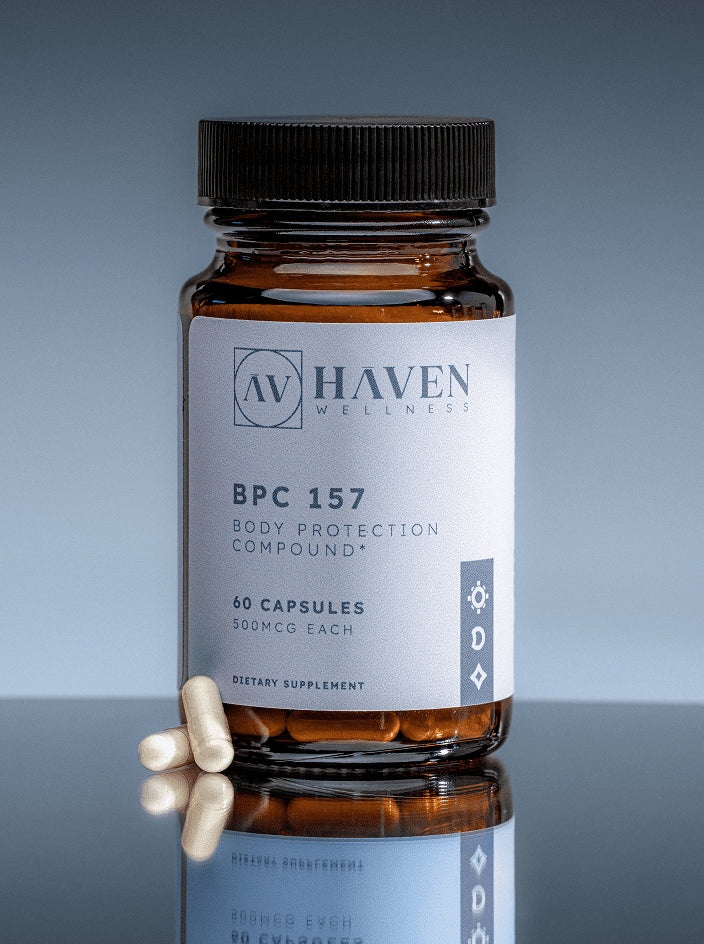
BPC-157
Recovery from exercise or injury, post-surgical recovery, joint pain, gut health (leaky gut, IBS, gastritis), connective tissue repair, anti-inflammatory support. The go-to recovery peptide for most practitioners.
Verified 2026-06-09 from product label (BPC-157_Facts.jpg).
- Serving Size: 1 Capsule · Servings Per Container: 60
- BPC-157 - 500 mcg (naturally occurring acetylated and amidated form of BPC-157)
- Other ingredients: Rice Flour, Acid Resistant Vegetable Capsule
- Distributed for Haven Wellness, PO Box 1079, Pleasant Grove, UT 84062 (haven-health.co)
What it is
An oral formulation of "Body Protection Compound-157," a 15-amino-acid synthetic peptide (Gly-Glu-Pro-Pro-Pro-Gly-Lys-Pro-Ala-Asp-Asp-Ala-Gly-Leu-Val; MW 1419.55 Da). It is a partial sequence of a "Body Protection Compound" originally isolated from human gastric juice by Sikiric and colleagues at the University of Zagreb (1993). Defining pharmacokinetic property - and the one that justifies oral capsules: BPC-157 is stable in human gastric juice for >24 hours, essentially unique among bioactive peptides (most degrade within minutes in the acidic, protease-rich stomach). The peptide reaches the small bowel intact, exerts local mucosal effects, and a fraction enters portal circulation.
What it does (mechanism)
Pleiotropic - no single canonical receptor identified. Three dominant axes:
- VEGFR2 / Akt / eNOS angiogenesis (Hsieh 2017 Sci Rep) - upregulates VEGF, drives capillary tube formation and NO production
- Src–Caveolin-1–eNOS vasomotor pathway (Hsieh 2020, PMC7555539) - releases tonic Cav-1 inhibition of eNOS
- GH receptor upregulation on tendon fibroblasts (Chang 2014, PMC6271067) - the mechanistic basis for GH/IGF-1 axis synergy and the consistent tendon-healing signal
Layered on top: anti-inflammatory cytokine modulation (↓IL-6, TNF-α, MPO), antioxidative (normalizes MDA/GSH), modulates dopamine/serotonin/GABA/NO systems, stabilizes NOS tone in either direction (counteracts both L-NAME blockade and L-arginine excess).
Used for
Recovery from exercise or injury, post-surgical recovery, joint pain, gut health (leaky gut, IBS, gastritis), connective tissue repair, anti-inflammatory support. The go-to recovery peptide for most practitioners.
Pairs well with
- TB4 Frag - the "Wolverine" repair stack. BPC drives angiogenesis; TB4 drives anti-fibrotic + macrophage modulation. Different repair phases. [Practitioner]
- KPV - gut healing stack. BPC rebuilds epithelium; KPV shuts down NF-κB inflammation at the transcription level. Most-prescribed integrative protocol for IBS/IBD/leaky gut/post-antibiotic dysbiosis/SIBO recovery. [Practitioner]
- Epitalon - recovery + longevity/sleep. Acute repair (BPC) + deep restorative sleep when GH pulses peak (Epitalon). Built into the Muscle Growth & Recovery Stack. [Practitioner]
Dosing
Haven recommended (label protocol)
- 1 capsule daily (500 mcg), oral, with or without food
- Empty stomach AM optimal for peptide bioavailability and mucosal contact
- Continuous use 30+ days for full effect
- No required cycling at this dose
Practitioner-directed [Practitioner]
- 1 cap BID (1 mg/day total) for active recovery / acute injury - split AM + PM, both empty stomach
- 1 cap TID (1.5 mg/day total) for severe IBD / aggressive gut healing, 4–6 weeks
- AM dose rationale: aligns with circadian peak of GH receptor expression + morning cortisol - leverages Chang 2014 GH-receptor mechanism when collagen turnover is highest
- PM dose rationale: tissue repair peaks during sleep when GH pulses fire
- Cycling rationale: 4–8 weeks on, 2–4 off - theoretical desensitization concern + absence of long-term human safety data
- Defer to Dr. Porter at integrativemedutah.com for individualized protocols
Cautions / contraindications
- Active or recent (<5 yr) cancer history - pro-angiogenic (VEGFR2/eNOS) + GH-receptor upregulation creates theoretical tumor-progression risk; no human data establishes causation; Sikiric argues for normalizing rather than maximally driving angiogenesis. Avoid until safety data exists.
- Pregnancy / lactation / pediatric - no data, avoid
- Diabetic retinopathy / proliferative vascular disease - theoretical concern from pro-angiogenic action
- Active hemorrhage / recent stroke - hold until acute bleeding resolved
- WADA-banned for competitive athletes - verify with tested athletes before use
- Not FDA-approved - sold via 503A/503B compounding pathways
- Anecdotal community side effects: mild GI upset, transient fatigue, occasional headache. No serious AEs reliably documented.
- [Caveat] ~80%+ of BPC-157 literature is from one group (Sikiric/Zagreb). Independent replication is limited. The Pliva PL-14736 Phase II ulcerative colitis trial was reported as safe and efficacious but never published in a peer-reviewed journal.
Key studies & references
- Sikiric P et al. 2020 - Stable Gastric Pentadecapeptide BPC 157, Robert's Cytoprotection - Gut and Liver 14:153 - PMID 31158953 / PMC7096228
- Vasireddi N et al. 2025 - Systematic Review: BPC-157 in Orthopaedic Sports Medicine - HSS Journal - 36 studies (35 preclinical, 1 clinical) - DOI 10.1177/15563316251355551
- Seiwerth S et al. 2021 - BPC 157 and Wound Healing - Front Pharmacol 12:627533
- Chang CH et al. 2014 - BPC 157 Enhances GH Receptor Expression in Tendon Fibroblasts - PMC6271067 (mechanism for GH/IGF-1 synergy)
- Cerovecki T et al. 2010 - BPC 157 improves ligament healing - J Orthop Res 28:1155
- Staresinic M et al. 2003 - Achilles tendon transection, accelerated healing - J Orthop Res 21:976
- Krivic A et al. 2006 - tendon-to-bone healing, opposed corticosteroid aggravation - PMID 16583442
- Hsieh MJ et al. 2017 - VEGFR2/Akt/eNOS angiogenic mechanism - J Mol Med
- Lee E, Padgett B 2021 - Intra-articular BPC-157 for knee pain - retrospective n=16; 11/12 reported pain reduction; no control, no blinding
---